


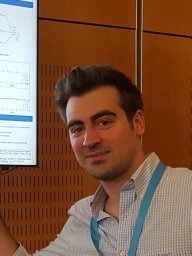
Who
Dr. Panagiotis Papageorgiou
When
22 Jan 2026, 11:00 Athens time, Science Building 145Π58
Title
Nonlinear Analysis of Modern Power Grids: From Dynamic Modeling to Control Design and Stability
Abstract
The structure and operation of modern power systems is constantly shifting to a more complex and decentralized paradigm, mainly due to the large-scale integration of distributed generation. Power converter-interfaced renewable energy sources (RES), storage units and other production units substitute the traditional synchronous generators. As a result, rotating inertia is reduced, and new fast response characteristics influence the grid dynamics. In addition, inputs coming from the power converter interfaces are introduced with nonlinear behaviors. In this frame, the classical synchronous machine-based linear modeling and regulation by applying simple feedback transfer functions are not adequate anymore for the dynamic analysis of power systems. To this end, a generalized nonlinear modeling approach identified as controlled-impedance-admittance-torque (CIAT), is presented that accurately represents both converter and full-scale electromechanical components and their dynamic interactions, leading into a holistic framework capable of verifying critical stability properties, regardless of changes in system topology or operating conditions. The unique structure of this formulation can also be extended to include fast synchronization dynamics, i.e. by phase-locked-loop (PLL) mechanisms, and also enables the design of advanced localized control schemes that achieve boundedness of critical system states or others that effectively enhance converter dynamic performance, all the while guaranteeing strong local or global stability properties. Finally, this approach is also presented in a context compatible with upper-level management designs and decision-making schemes for grid-forming converter-based power system layouts, highlighting its wide applicability.
About the Speaker
Dr. Panagiotis Papageorgiou received the B.S., M.S., and Ph.D. degrees in electrical and computer engineering from the Department of Electrical and Computer Engineering, University of Patras, Patras, Greece, in 2015, 2016, and 2021, respectively. He is currently a Research Associate with the Power Systems, Renewable and Distributed Generation Laboratory at the same department. His current research interests include modelling, control and stability analysis for a large class of nonlinear dynamic systems, with main emphasis on modern power grid layouts featuring large-scale integration of distributed generation. He has authored more than 40 papers in International scientific journals and conferences. He is a member of the IEEE Power & Energy and IEEE Industrial Electronics Societies and a member of the National Technical Chamber of Greece.

