

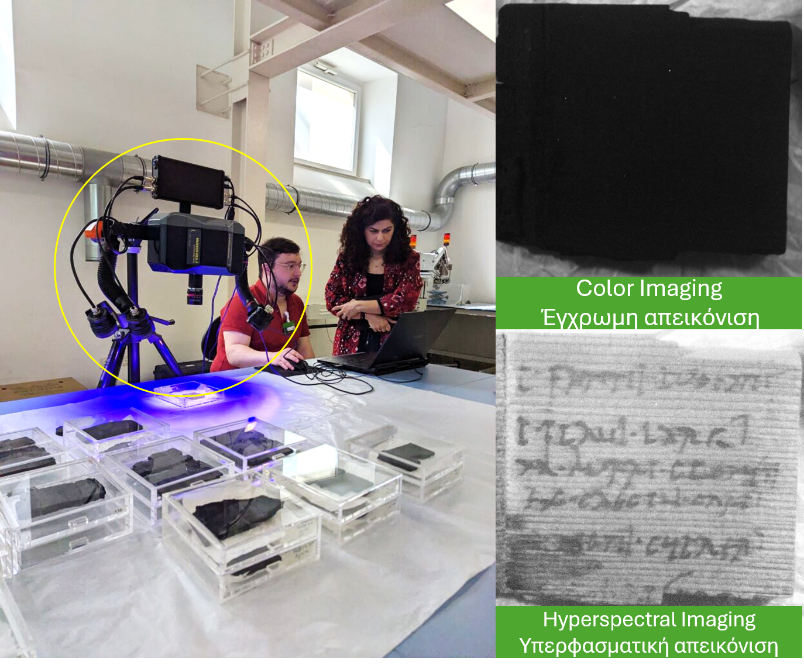
Hyperspectral imaging is a rapidly advancing, nondestructive analytical method that records not just colors but also provides detailed information about the chemical composition at every location within an image. Additionally, it expands our vision into invisible parts of the optical spectrum, allowing opaque objects to appear transparent, thus exposing their internal features.
Despite significant research efforts and investments allocated towards improving this fascinating technology, hyperspectral imaging has been limited by a narrow frequency range close to the visible spectrum and by low image quality comparable to that of 1970s camcorders.
Decades of groundbreaking research led by Professor Costas Balas have successfully closed numerous scientific and technological gaps in the field. Under his guidance, a team of talented scientists and engineers—most of whom graduated from the ECE department at TUC—created a novel hyperspectral camera that provides artificial vision and spectroscopy over the broadest frequency range and with the higher image resolution globally.
The new technology was quickly adopted and set up at the University of Hamburg's Centre for the Study of Manuscript Cultures. In April 2026, it was moved to the National Archaeological Museum of Naples-Italy as part of the collaborative project “TabulaRasa”. The study aimed to explore one of the most difficult types of ancient written artifacts: the carbonized Roman wax tablets from Pompeii and Herculaneum. Specifically, the mission sought to tackle a long-standing challenge in the study of ancient manuscripts: how to identify and interpret the almost invisible ink marks on carbonized writing surfaces.
Roman tablets were commonly used for writing everyday’ s life documents. Ink writing, particularly poses a special difficulty, especially with the Vesuvian tablets. Since these items were buried and carbonized during the eruption of Mount Vesuvius in 79 CE, the wooden surfaces became blackened, causing dark ink—especially carbon-based ink—to blend almost completely with the background.
By exploiting the broad frequency spectrum spanning from ultraviolet to deep infrared, along with the ultra-high-definition imaging features of the new hyperspectral imager, the ink marks appeared almost "magically". At critical invisible frequencies they ancient writings popup with strong contrast against their background, making them visible once more after 2000 years. A notably significant achievement was the recovery of a fragment from Herculaneum that included a mention of olive harvesting.
The innovative technology introduces new possibilities for nondestructive analysis of natural or artificial materials, with numerous new applications that are currently being actively researched and developed.
Key team members: Athanasios Tsapras, M. Eng, MSc, Charalambos Boras M. Eng, Dr. Nikolaos Kaminakis, Dr. Gianni Nteroli and Ioannis Roidis
Links

